

This gentle, flowing pattern shows how a simple radial structure can grow into a soft, dimensional bloom through layered curves and mindful repetition. Bownus is a wonderful pattern for slowing down, practicing confident curved strokes, and experiencing the meditative rhythm of pattern drawing.
This step-by-step pattern was drawn and shared by Saleha. The pattern itself, Bownus, was originally created by Angie Gittles. We are sharing this tutorial as an educational and inspirational reference with full credit to both artists.
At Doodle Art Club, we love showing how patterns travel through the creative community — evolving as artists explore them, reinterpret them, and generously share their process.
About the Pattern
Bownus is a radial, botanical-style pattern that begins from a simple center point and grows outward through repeating, petal-like forms. Each round adds softness, movement, and depth, making it an excellent exercise for both beginners and experienced doodlers.
This pattern is especially helpful for:
- practicing confident curved strokes
- understanding spacing in radial designs
- building volume through line direction
- developing a calm, steady drawing rhythm
Bownus works beautifully as a standalone tile or as a focal element within a larger composition.
Step-by-Step Drawing Instructions
Step 1
Begin by lightly marking the center of your square tile. Add faint guide lines if needed to divide the space evenly and help maintain balance as the pattern grows outward.
Step 2
From the center point, draw four rounded, petal-like strokes extending outward in a cross formation. Keep the shapes soft and slightly tapered, similar to elongated drops.
Step 3
Between the existing petals, add gentle curved strokes that begin at the center and arc outward. These lines introduce movement and soften the initial structure.

Step 4
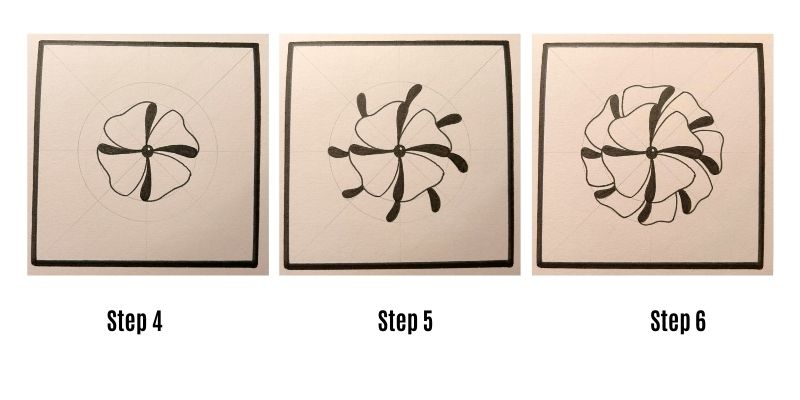
Connect and shape the spaces between the petals by adding flowing curves that wrap around the inner form. The bloom should start to feel more organic and less rigid.
Step 5
Continue building outward with another layer of curved strokes, weaving them between the existing shapes. Slight variations in direction will create a subtle sense of rotation.
Step 6
Refine the outer edge of the bloom using continuous, ribbon-like lines. Allow the curves to overlap visually, giving the pattern a folded, dimensional appearance.
Step 7
If using guide lines or a frame, lightly reinforce the surrounding structure while keeping the bloom as the focal point of the tile.
Step 8
Add fine, parallel line work inside each petal, following the natural curve of the shape. This shading builds volume and enhances the three-dimensional look.
Step 9
Finish by adjusting line weight, deepening contrast where needed, and cleaning up any remaining guide lines. The final bloom should feel balanced, soft, and visually calm.
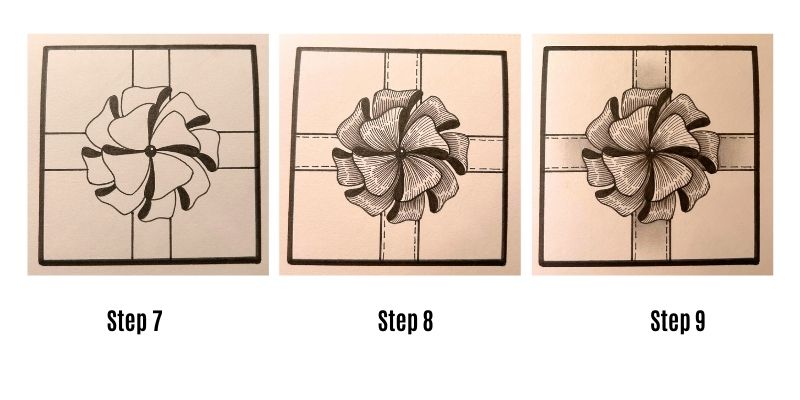
The completed Bownus bloom has a gentle, floral presence with layered movement and subtle depth. It’s a beautiful example of how simple strokes, repeated with intention, can create a rich and meditative pattern.
Artist Credits
Pattern: Bownus by Angie Gittles
Step-out drawing: Saleha. You can find more of Saleha’s artwork and pattern explorations on Facebook under the name: What Saleha Did
We are grateful to artists who inspire others by openly sharing their work and creative journey!


