

Some patterns appear complex at first glance, yet are built from the simplest repeated movements. Ternum, also widely known as Paradox, is one of those designs.
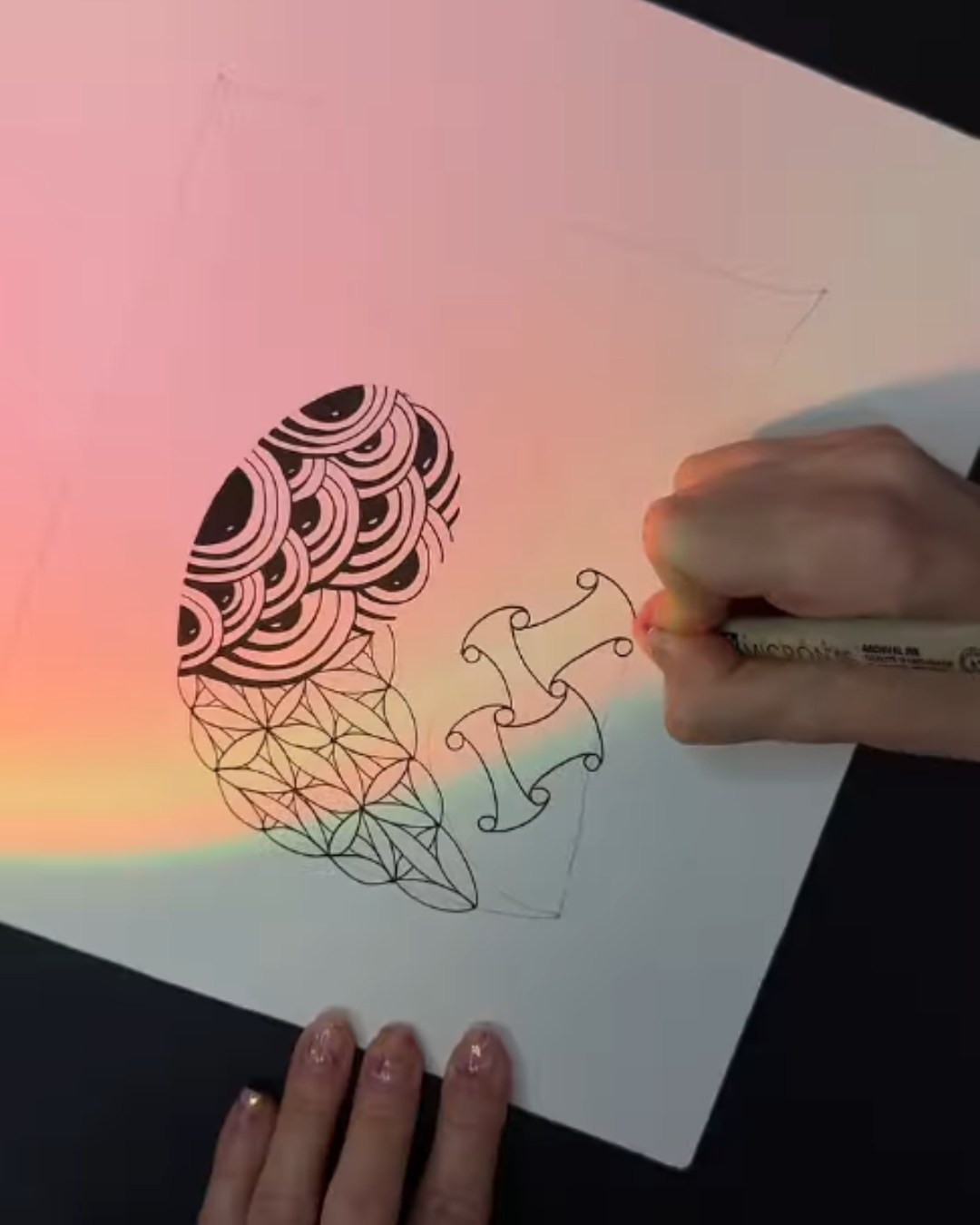
Ternum is a geometric pattern created from angled lines that gradually rotate inward. As you repeat the motion, the form naturally tightens toward the center, creating depth, rhythm, and a strong sense of movement.
This pattern looks complex, but once you understand the direction, it becomes calm, repetitive, and almost meditative to draw.
Step-by-Step Drawing Instructions
Step 1
Draw a straight line from the bottom left corner of your square, angled slightly toward the top edge.
Step 2
Add another straight line near the top area, keeping approximately the same angle.
Step 3
Continue adding lines, allowing the direction to slowly rotate inward.

Step 4
Keep repeating the same angled motion, connecting one side of the square to another.
Step 5
As you continue, the spiral structure begins to appear naturally.
Step 6
Add lines until the shape tightens toward the center and forms a compact geometric swirl.
Tip
Rotate your paper while drawing. Turning the page helps you maintain a consistent angle, making the structure cleaner and more balanced.

Line Density Changes the Effect
Spacing makes a big difference.
If the lines are farther apart, the pattern feels more structured and angular.
If the lines are closer together, the spiral becomes smoother and more dramatic.
Try both versions and see which mood you prefer.

Combining Ternum Tiles
Once you understand the structure, you can begin combining multiple squares into larger compositions.

Option 1 – Same Direction Flow
When every square rotates in the same direction (all clockwise or all counterclockwise), the movement flows continuously from one section to the next.
You can place squares in a single row for a border effect.

Or arrange four squares together to create a strong vortex-like center. The rotation feels powerful and unified.

Option 2 – Alternating Direction
If you alternate the spiral direction from square to square, the movement opens outward instead of circling continuously.
This creates a fan-like or unfolding effect.

When four alternating sections are combined, the shapes interact in a balanced and symmetrical way.

Beyond the Square
Ternum (Paradox) is not limited to squares.
It works beautifully inside triangles, pentagons, hexagons, and other polygons. Squares and triangles tend to produce the most stable results, while shapes with more sides create tighter, more complex centers.






Wow! Love it!